

Table of Contents
ToggleAI Business Systems for SMEs
Most SMEs do not need more AI tools.
They need better systems.
The challenge is not access to technology. Businesses already have access to AI assistants, automation platforms, CRM systems, analytics tools and productivity software.
The real challenge is turning those tools into repeatable workflows that improve how the business operates.
This is where AI Business Systems become valuable.
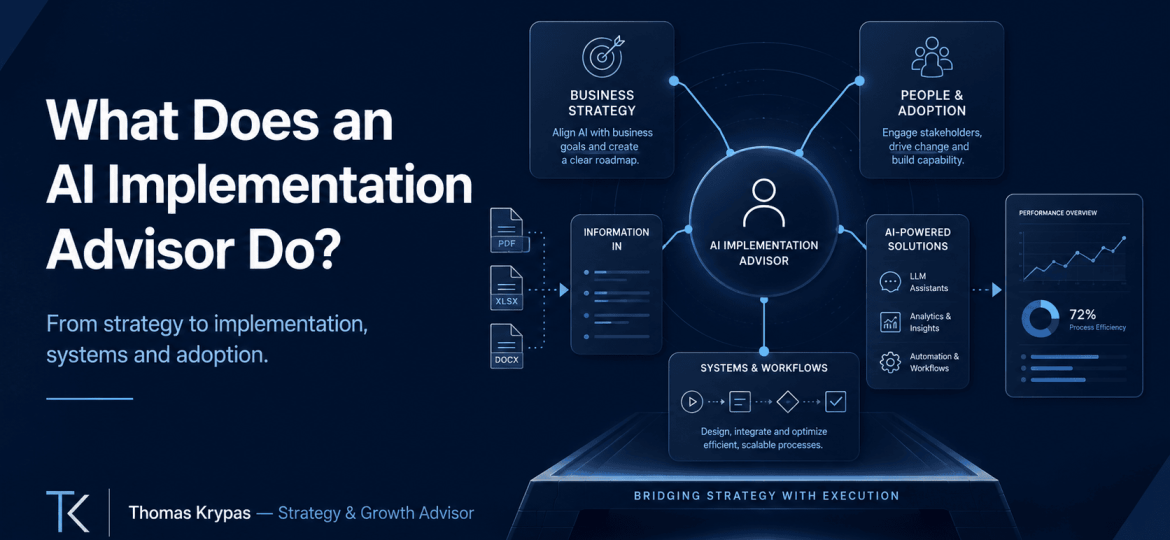
An AI Business System connects AI, people, data, tools and processes around a specific business outcome.
It may help a company create proposals faster, follow up with leads, produce content, organise customer enquiries or improve reporting.
The objective is not to use AI everywhere.
It is to use AI where it reduces friction, saves time and improves business performance.
What Is an AI Business System?
An AI Business System is a structured workflow that uses artificial intelligence to support or automate part of a business process.
It is more than a single AI tool.
A complete AI Business System usually includes:
- A clear business objective
- Defined inputs
- AI-supported tasks
- Human review or approval
- Connected tools
- Storage and documentation
- Rules and responsibilities
- Performance metrics
For example, asking an AI assistant to write a proposal is not a complete system.
A proposal system may include:
- Discovery notes are captured.
- AI summarises the client’s needs.
- A proposal draft is generated.
- Pricing and scope are added.
- A consultant reviews the output.
- A follow-up email is prepared.
- The proposal is stored in the CRM.
- The next action is scheduled.
The value comes from the full process, not only from the AI-generated document.
Why SMEs Need AI Business Systems
SMEs often operate with limited time, budgets and internal resources.
Employees may manage multiple responsibilities, while important processes depend on manual work, spreadsheets, emails and personal knowledge.
This creates common problems:
- Slow response times
- Repeated manual tasks
- Inconsistent outputs
- Lost information
- Weak follow-up
- Limited reporting
- Dependence on specific employees
- Difficulty scaling operations
AI Business Systems can help SMEs standardise and improve these processes.
They can support employees, reduce repetitive work and make workflows easier to manage.
The goal is not necessarily to replace people.
It is to help people work with greater speed, consistency and clarity.
AI Tools vs AI Business Systems
An AI tool performs a task.
An AI Business System supports an outcome.
For example:
- An AI tool can write an email.
- An AI Business System can capture a lead, qualify the opportunity, prepare a personalised response, update the CRM and schedule the next action.
- An AI tool can summarise a meeting.
- An AI Business System can store the summary, identify action items, assign owners and create follow-up tasks.
- An AI tool can create content.
- An AI Business System can organise ideas, draft posts, adapt formats, schedule content and track performance.
The difference is structure.
Standalone tool usage often depends on individual effort.
A system creates a repeatable process that the business can use consistently.
Practical AI Business Systems for SMEs
1. AI Proposal and Follow-Up System
Many service businesses spend significant time turning discovery conversations into proposals.
An AI Proposal and Follow-Up System can help organise this process.
The workflow may include:
- Capturing discovery call notes
- Summarising client needs
- Identifying goals and challenges
- Drafting the proposal structure
- Creating scope and deliverables
- Preparing follow-up emails
- Storing documents
- Scheduling the next action
This can be particularly useful for:
- Consultants
- Agencies
- Professional services firms
- Freelancers
- B2B service businesses
The system reduces proposal creation time and improves consistency.
Human review remains essential, especially for pricing, scope and strategic recommendations.
2. AI Lead Management System
Lead management often becomes fragmented when enquiries arrive through different channels.
An AI Lead Management System can help capture, organise and prioritise leads.
The workflow may include:
- Collecting lead information
- Summarising the enquiry
- Classifying the opportunity
- Identifying intent
- Preparing a personalised response
- Updating the CRM
- Suggesting the next step
- Creating reminders
This can help sales teams respond faster and avoid missed opportunities.
The system can also support lead qualification by highlighting factors such as:
- Urgency
- Budget indicators
- Business need
- Company profile
- Service fit
- Buying intent
AI should support qualification, not make final commercial decisions without review.
3. AI Content and Authority System
Many SMEs know they need consistent content but struggle with time, structure and execution.
An AI Content and Authority System can help turn internal expertise into publishable content.
The workflow may include:
- Capturing ideas
- Organising topics
- Researching supporting information
- Creating first drafts
- Adapting content for different channels
- Preparing newsletters
- Repurposing long-form content
- Maintaining a content calendar
- Tracking performance
The system can support:
- LinkedIn posts
- Blog articles
- Newsletters
- Case studies
- FAQs
- Educational content
- Sales enablement materials
The business still needs a clear point of view.
AI can structure and accelerate content, but it should not replace expertise or original thinking.
4. AI Customer Enquiry System
Customer enquiries can create significant operational pressure, especially for smaller teams.
An AI Customer Enquiry System can help organise and support responses.
The workflow may include:
- Receiving the enquiry
- Classifying the request
- Identifying urgency
- Retrieving relevant information
- Preparing a suggested response
- Escalating complex cases
- Updating the customer record
- Tracking resolution time
This can improve response speed and consistency.
It can also help identify recurring questions that should become:
- FAQs
- Knowledge base articles
- Templates
- Standard operating procedures
- Training materials
Human review is particularly important for sensitive, financial, legal or high-risk enquiries.
5. AI Reporting and Decision Support System
Many SMEs spend hours collecting information from spreadsheets, platforms and reports.
An AI Reporting System can help turn data into clearer management information.
The workflow may include:
- Collecting data
- Cleaning and organising information
- Summarising performance
- Highlighting changes
- Identifying anomalies
- Creating management summaries
- Suggesting questions for further review
- Preparing dashboards
- Useful reporting areas include:
- Sales performance
- Marketing results
- Cash flow
- Customer service
- Operations
- Inventory
- Project delivery
AI can help identify patterns, but management should still validate the data and business context.
6. AI Knowledge Management System
Important knowledge often exists across emails, documents, folders and individual employees.
An AI Knowledge Management System can help make this information easier to find and use.
The system may include:
- Policies
- Procedures
- Product information
- Training materials
- Client documents
- Internal guides
- Templates
- Frequently asked questions
Employees can then search or ask questions based on approved company information.
This can help with:
- Onboarding
- Internal support
- Faster decision-making
- Reduced dependency on individuals
- Consistent information
The quality of the system depends on the quality and accuracy of the source material.
7. AI Workflow Documentation System
Many SMEs rely on informal processes.
Employees know how tasks are completed, but the workflow may not be documented.
An AI Workflow Documentation System can help turn notes, interviews or recordings into structured process documents.
The system may support:
- Process mapping
- SOP creation
- Role clarification
- Checklist creation
- Training materials
- Quality controls
- Workflow improvement
This can be especially valuable when:
- The company is growing
- New employees are joining
- Processes vary between team members
- Knowledge is concentrated in one person
- Management wants to standardise operations
AI can accelerate documentation, but employees should verify that the final process reflects how the work is actually completed.
What Makes an AI Business System Effective?
Not every automation creates value.
An effective AI Business System should have several characteristics.
It Solves a Real Business Problem
The system should address a clear issue.
Examples include:
- Slow proposals
- Missed leads
- Inconsistent follow-up
- Manual reporting
- Repeated customer questions
- Poor documentation
- Content bottlenecks
The problem should be defined before tools are selected.
It Has a Clear Owner
Every system needs someone responsible for:
- Performance
- Accuracy
- Updates
- Approvals
- Improvement
Without ownership, systems quickly become outdated or underused.
It Includes Human Review
AI outputs are not automatically correct.
The workflow should clearly define:
- What AI can complete
- What employees must review
- Who approves final outputs
- When escalation is necessary
Human oversight is especially important for decisions involving customers, finance, compliance, legal matters or reputation.
It Connects with Existing Workflows
The system should fit the way the business already operates.
This may involve integration with:
- CRM platforms
- Cloud storage
- Project management systems
- Spreadsheets
- Calendars
- Forms
- Communication tools
A system that requires too many additional steps may create more complexity than value.
It Can Be Measured
Businesses should define how success will be evaluated.
Possible metrics include:
- Time saved
- Response time
- Conversion rate
- Number of tasks automated
- Reduction in errors
- Employee usage
- Customer satisfaction
- Cost reduction
- Output volume
- Revenue contribution
Without measurement, it is difficult to know whether the system is useful.
How to Choose Which AI Business System to Build First
SMEs should avoid trying to automate everything at once.
The best starting point is usually a workflow that is:
- Repeated frequently
- Time-consuming
- Easy to understand
- Low to moderate risk
- Based on available information
- Connected to a clear business result
A simple prioritisation framework can assess each use case based on:
- Impact
- Effort
- Risk
- Data readiness
- Team readiness
- Speed to value
The ideal first project is often a system with high impact and manageable complexity.
Examples may include:
- Proposal creation
- Lead follow-up
- Meeting summaries
- Content repurposing
- Monthly reporting
- Customer enquiry classification
A successful first system can create confidence and provide lessons for future implementation.
How to Implement an AI Business System
Step 1: Map the Current Workflow
Document how the process works today.
Identify:
- Inputs
- Tasks
- People involved
- Tools used
- Delays
- Repeated work
- Common errors
- Approval points
Step 2: Define the Desired Outcome
Decide what the system should improve.
This may include:
- Faster completion
- Better consistency
- Higher conversion
- Lower cost
- Improved reporting
- Reduced manual work
Step 3: Identify AI-Supported Tasks
Decide which tasks AI can support.
Examples include:
- Summarising
- Classifying
- Drafting
- Extracting information
- Comparing data
- Generating recommendations
- Preparing reports
Step 4: Define Human Responsibilities
Decide who will:
- Review outputs
- Approve decisions
- Handle exceptions
- Update information
- Monitor performance
H3: Step 5: Select the Tools
Choose tools based on the workflow.
Avoid selecting technology before the process is clear.
Step 6: Run a Pilot
Test the system with a limited number of users or cases.
Collect feedback and identify problems.
Step 7: Measure Results
Compare performance before and after implementation.
Step 8: Improve and Expand
Once the system works reliably, improve the workflow or expand it to similar use cases.
Common Mistakes SMEs Should Avoid
Starting with the Tool
Buying a platform before understanding the process often leads to wasted investment.
Automating a Broken Process
Automation can make an inefficient process run faster without making it better.
The workflow should be reviewed before it is automated.
Removing Human Oversight
AI should not be given full responsibility for high-impact decisions without review.
Ignoring Data Privacy
Employees need clear guidance about which information can be entered into AI tools.
Building Too Much Too Soon
Complex systems create adoption and maintenance challenges.
Start small and expand gradually.
Failing to Train the Team
A system only creates value when employees understand how and when to use it.
Are AI Business Systems Only for Large Companies?
No.
SMEs can often implement AI Business Systems faster than larger organisations because they have:
- Shorter decision-making processes
- Smaller teams
- Fewer legacy systems
- Clearer operational problems
- Greater flexibility
The system does not need to be technically complex.
A useful AI Business System may combine existing tools, clear prompts, simple automations and human review.
The value depends on the business outcome, not the technical sophistication.
When Should an SME Work with an AI Implementation Advisor?
An SME may benefit from external support when:
- The company has many AI ideas but no priorities.
- Different employees use different tools.
- Management does not know which workflows to automate.
- The business wants to avoid unnecessary software costs.
- There are concerns about privacy or governance.
- The team has completed training but has not implemented practical workflows.
Existing AI experiments are not producing measurable results.
An AI Implementation Advisor can help map the business processes, prioritise use cases and design systems that fit the organisation.
Final Thoughts
AI Business Systems help SMEs move from occasional tool usage to structured implementation.
They connect business goals, workflows, tools, data and people around a measurable outcome.
The strongest systems are not always the most complex.
They are the systems that solve a real problem, fit existing operations and are used consistently by the team.
For SMEs, the right approach is usually to start with one focused workflow.
Test it.
Measure it.
Improve it.
Then expand.
The goal is not to automate everything.
It is to build a business that operates with greater speed, consistency and clarity.
🤔Frequently Asked Questions
What is an AI Business System?
An AI Business System is a structured workflow that uses AI to support or automate part of a business process. It combines tools, people, data, rules and human review around a specific outcome.
What AI systems can an SME use?
SMEs can use AI systems for proposals, lead management, content creation, customer enquiries, reporting, knowledge management and workflow documentation.
Are AI Business Systems expensive?
Not necessarily. Many SMEs can begin with existing tools, simple automation platforms and a focused workflow. Costs increase when custom integrations or development are required.
Do AI Business Systems replace employees?
In most cases, they support employees by reducing repetitive work and improving consistency. Human judgement, review and decision-making remain important.
How should an SME choose its first AI system?
Choose a workflow that is repetitive, time-consuming, clearly defined and connected to a measurable business outcome.
Can AI Business Systems use existing software?
Yes. Many systems can connect with existing tools such as CRM platforms, email, Microsoft 365, Google Workspace, project management software and cloud storage.
How long does it take to implement an AI Business System?
The timeline depends on the complexity of the workflow. A focused pilot using existing tools may be implemented relatively quickly, while custom integrations may require more time.
Where could AI remove friction from your business?
An AI Business Systems Review can identify the workflows with the highest potential, prioritise the right use cases and create a practical implementation plan.