

Table of Contents
ToggleHow to Choose the proper Digital Transformation Advisor for your business
Digital transformation is often presented as a technology project.
In reality, it is a business change programme.
It affects how a company operates, makes decisions, serves customers, uses data and organises its people.
The right Digital Transformation Advisor should therefore do more than recommend software.
Should help leadership understand what needs to change, why it matters, what should happen first and how the organisation will move from strategy to execution.
Choosing the right advisor is important because the wrong approach can create:
- Unnecessary technology costs
- Disconnected tools
- Low employee adoption
- Complex processes
- Weak business results
- Transformation fatigue
The strongest advisor is not necessarily the person with the most technical language.
It is the person who can connect strategy, operations, technology, people and measurable outcomes.
What Does a Digital Transformation Advisor Do?
A Digital Transformation Advisor helps organisations improve how they operate by using technology, data, processes and new ways of working.
The role may include:
- Assessing the current business model
- Reviewing operations and workflows
- Identifying digital gaps
- Prioritising transformation initiatives
- Creating a transformation roadmap
- Supporting technology selection
- Improving customer journeys
- Redesigning processes
- Strengthening data use
- Supporting AI adoption
- Defining governance
- Helping teams manage change
- Tracking implementation results
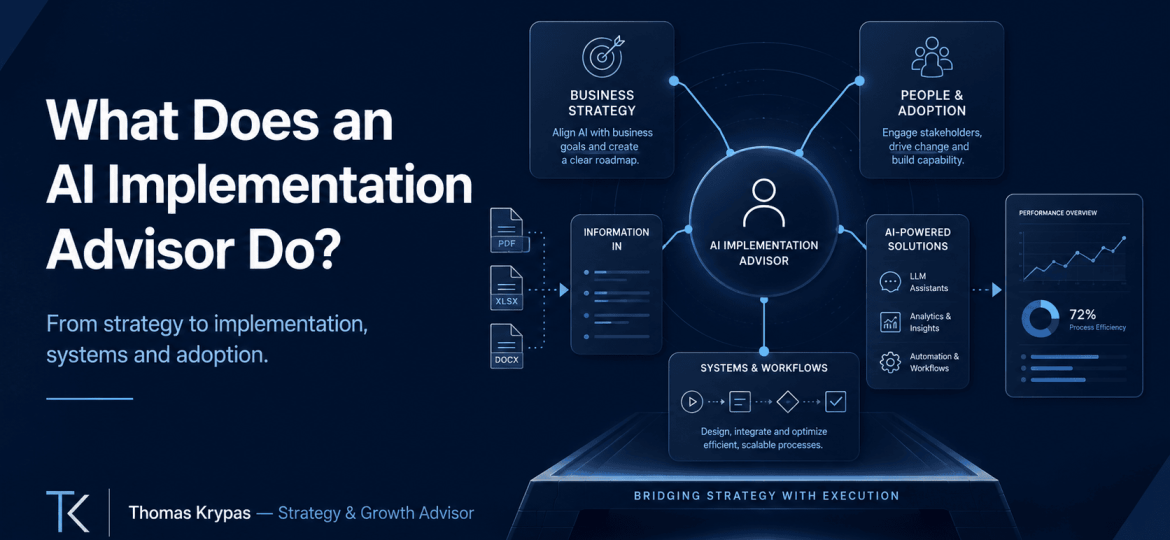
The role sits between business strategy and practical execution.
A good advisor should understand technology, but should begin with the business.
When Does a Business Need a Digital Transformation Advisor?
A business may need external support when:
- Technology investments are not producing results.
- Departments use disconnected systems.
- Processes depend heavily on spreadsheets, emails or manual work.
- Leadership wants to introduce AI but lacks clear priorities.
- Customer experience is inconsistent across channels.
- Reporting is slow or unreliable.
- Teams resist new systems.
- The company is growing, but operations are not scalable.
Management has too many digital initiatives and no clear roadmap.
Internal teams are focused on daily operations and lack transformation capacity.
The advisor should bring structure, objectivity and direction.
They should help the company make better decisions before it invests further.
Start by Defining What You Actually Need
Before selecting an advisor, clarify the problem.
Digital transformation can mean very different things depending on the organisation.
It may involve:
- Modernising internal systems
- Improving customer experience
- Introducing AI
- Automating workflows
- Connecting sales and marketing
- Improving reporting
- Redesigning operations
- Strengthening digital capability
- Building a new digital business model
An organisation that needs better management reporting requires a different approach from one that wants to redesign its customer journey.
The clearer the business problem, the easier it becomes to evaluate the right advisor.
What to Look for in a Digital Transformation Advisor
1. Strong Business Understanding
The advisor should understand how the business creates value.
This includes:
- Revenue model
- Customer segments
- Operating model
- Cost structure
- Growth priorities
- Competitive position
- Management challenges
A transformation plan that ignores these factors is likely to become a technology exercise.
Ask whether the advisor can explain how the proposed changes will support:
- Growth
- Efficiency
- Customer experience
- Decision-making
- Risk reduction
- Scalability
The advisor should be able to connect every initiative with a business outcome.
2. Ability to Connect Strategy with Execution
Many transformation projects fail between the strategy document and daily implementation.
The advisor should be able to move from high-level direction to practical action.
This includes defining:
- Priority initiatives
- Owners
- Timelines
- Required resources
- Dependencies
- Risks
- Success metrics
- Governance
The roadmap should make clear what happens next.
It should not remain a theoretical presentation.
3. Experience with Processes, Not Only Technology
Technology cannot fix a poorly designed process on its own.
A strong advisor should examine how work is completed today.
They should identify:
- Repeated manual work
- Delays
- Approval bottlenecks
- Duplicated tasks
- Disconnected information
- Unclear responsibilities
- Low-value activities
The process should be improved before it is automated.
Otherwise, the business may simply automate inefficiency.
4. Technology Independence
A Digital Transformation Advisor should not force every problem into one platform or vendor.
The recommendation should be based on business requirements.
Evaluate whether the advisor considers:
- Existing systems
- Integration options
- Team capability
- Data privacy
- Cost
- Scalability
- Maintenance
- Long-term fit
A credible advisor may recommend improving existing tools instead of replacing them.
Technology independence reduces the risk of unnecessary investment.
5. Understanding of AI and Automation
Modern digital transformation increasingly includes AI and workflow automation.
The advisor should understand where these technologies can create value.
This may include:
- AI-assisted decision support
- Workflow automation
- Knowledge systems
- Customer service support
- Sales enablement
- Content operations
- Reporting
- Forecasting
- Process documentation
However, they should not recommend AI simply because it is popular.
They should be able to explain:
- Which use cases are valuable
- Which are premature
- What data is required
- Where human oversight is needed
- How risks will be managed
- How results will be measured
6. Change Management Capability
Transformation affects people.
Employees may need to change tools, workflows, responsibilities or habits.
A strong advisor should therefore understand:
- Stakeholder engagement
- Leadership alignment
- Communication
- Training
- Adoption
- Resistance
- Capability building
- Feedback loops
A new platform can be technically successful and still fail because teams do not use it.
The advisor should treat adoption as part of the transformation, not as an afterthought.
7. Clear Approach to Governance
Transformation initiatives create decisions about data, tools, ownership and accountability.
The advisor should help define:
- Who owns each initiative
- Who approves changes
- How data is managed
- Which tools are approved
- How risks are escalated
- How progress is reviewed
- How priorities are updated
Without governance, transformation programmes often become fragmented.
8. Ability to Measure Results
A Digital Transformation Advisor should define how success will be measured.
Useful metrics may include:
- Time saved
- Cost reduction
- Process speed
- Customer satisfaction
- Digital adoption
- Error reduction
- Revenue contribution
- Lead conversion
- Reporting speed
- Employee productivity
- System usage
Avoid advisors who focus only on deliverables such as presentations, workshops or tool deployments.
The real question is whether the business performs better after the transformation.
Questions to Ask a Digital Transformation Advisor
Before selecting an advisor, ask:
- How do you assess the current state of the business?
- How do you connect transformation initiatives with business goals?
- How do you prioritise projects?
- How do you approach process redesign?
- How do you evaluate technology options?
- How do you handle AI and automation opportunities?
- How do you support employee adoption?
- How do you define success metrics?
- How do you manage risks and governance?
- What will leadership need to provide?
- How do you move from recommendations to implementation?
- How do you prevent the roadmap from becoming too complex?
The quality of the answers matters more than the use of technical terminology.
What Should a Digital Transformation Roadmap Include?
A practical roadmap should include:
- Current-state assessment
- Business priorities
- Transformation objectives
- Priority workstreams
- Expected outcomes
- Required capabilities
- Technology considerations
- Implementation phases
- Owners and responsibilities
- Dependencies
- Risks
- Success metrics
- Review points
The roadmap should distinguish between:
- Quick wins
- Foundational changes
- Medium-term initiatives
- Longer-term transformation opportunities
For SMEs, simplicity is especially important.
A roadmap with too many initiatives can overwhelm the organisation.
Digital Transformation Advisor vs Technology Vendor
A technology vendor sells or implements a specific product.
A Digital Transformation Advisor should take a broader view.
The vendor asks:
How can this platform be deployed?
The advisor asks:
- What does the business need?
- Which process should change?
- Is this platform the right choice?
- What should happen before implementation?
- How will employees use it?
- How will success be measured?
Technology vendors can be valuable implementation partners.
However, the business may still need independent strategic guidance.
Digital Transformation Advisor vs Traditional Consultant
A traditional management consultant may focus on business strategy, organisational design or performance improvement.
A Digital Transformation Advisor combines these areas with technology, data, AI and implementation.
The role should bring together:
- Strategic thinking
- Operational understanding
- Technology awareness
- Change management
- Execution planning
The strongest advisor does not separate digital from the rest of the business.
They treat transformation as part of the operating model.
🚩Red Flags to Avoid
Recommending Tools Before Understanding the Business
The advisor should diagnose before prescribing.
Using Too Much Technical Language
Complex language can hide weak business thinking.
The advisor should be able to explain recommendations clearly.
Promising Transformation Without Organisational Change
Technology alone will not transform the business.
Ignoring Employee Adoption
A plan that excludes communication, training and behaviour change is incomplete.
Treating Every Initiative as Urgent
Good advisors prioritise.
They do not try to transform everything at once.
Focusing Only on Innovation
Transformation should improve business performance, not only create the appearance of innovation.
Providing a Generic Roadmap
The roadmap should reflect the company’s strategy, maturity, resources and constraints.
Avoiding Measurement
If success cannot be measured, the organisation cannot evaluate the investment.
What Should the Engagement Process Look Like?
A typical advisory engagement may include several stages.
Stage 1: Discovery
The advisor reviews:
- Business goals
- Current systems
- Processes
- Challenges
- Data
- Team capability
- Leadership priorities
Stage 2: Assessment
The advisor identifies:
- Digital gaps
- Operational bottlenecks
- Customer experience issues
- Technology risks
- AI opportunities
- Capability gaps
Stage 3: Prioritisation
Initiatives are ranked based on:
- Business impact
- Effort
- Risk
- Cost
- Readiness
- Speed to value
Stage 4: Roadmap
A structured transformation plan is created.
Stage 5: Pilot Implementation
One or more focused initiatives are tested.
Stage 6: Adoption and Scaling
The business trains teams, improves governance and expands successful initiatives.
Stage 7: Measurement and Review
Results are reviewed and the roadmap is updated.
How Much Should a Digital Transformation Advisor Understand About Your Industry?
Industry knowledge is valuable, but it should not be the only selection criterion.
An advisor should understand the commercial and operational realities of the sector.
However, broader transformation experience can also bring useful ideas from other industries.
The right balance is:
- Understanding your sector
- Understanding business models
- Understanding transformation patterns
- Ability to learn quickly
- Ability to adapt recommendations
The advisor should not rely on generic industry templates.
What Outcomes Should You Expect?
A strong engagement should create greater clarity and execution capability.
Expected outcomes may include:
- Clear transformation priorities
- Better alignment between leadership and teams
- More efficient workflows
- Improved use of technology
- Faster decision-making
- Stronger reporting
- Better customer experience
- Higher digital adoption
- Lower operational friction
- A practical implementation roadmap
- More confident investment decisions
The advisor should help the organisation make better choices, not create dependence.
How to Make the Final Decision
When comparing advisors, evaluate them across five areas:
- Business understanding
- Strategic clarity
- Implementation capability
- Change management
- Measurement
Do not choose only based on presentations, certifications or tool knowledge.
Choose the advisor who:
- Understands the business problem
- Challenges unclear assumptions
- Explains priorities clearly
- Avoids unnecessary complexity
- Connects technology with outcomes
- Can work with leadership and teams
- Builds a realistic path to execution
The best advisor should make the transformation feel clearer, not more confusing.
Final Thoughts
Choosing a Digital Transformation Advisor is not simply a procurement decision.
It is a strategic decision about how the organisation will change.
The right advisor should connect business strategy, processes, technology, people and measurable outcomes.
They should help the company understand what to transform, what not to transform and what should happen first.
The objective is not to become more digital for its own sake.
It is to build a business that is more responsive, efficient, scalable and capable of making better decisions.
Frequently Asked Questions
What does a Digital Transformation Advisor do?
A Digital Transformation Advisor helps organisations improve business performance through better processes, technology, data, AI and new ways of working.
When should a company hire a Digital Transformation Advisor?
A company may need an advisor when technology investments are disconnected, operations are inefficient, digital initiatives lack direction or leadership needs a practical transformation roadmap.
How do I choose a digital transformation consultant?
Evaluate their business understanding, process experience, technology independence, implementation capability, change management approach and ability to measure results.
Should a Digital Transformation Advisor understand AI?
Yes. AI and automation are increasingly part of transformation, but the advisor should connect them to clear business needs rather than recommend them as trends.
What is the difference between a digital advisor and a technology vendor?
A digital advisor focuses on business needs and transformation priorities. A technology vendor usually focuses on selling or implementing a specific product.
What should a digital transformation roadmap include?
It should include the current state, business objectives, priority initiatives, implementation phases, owners, risks, required capabilities and success metrics.
Can SMEs benefit from digital transformation advisory?
Yes. SMEs can benefit significantly because focused process improvements, better systems and clearer priorities can create measurable impact without requiring a large transformation programme.
Is your business investing in technology without a clear transformation roadmap?
A Digital Transformation Review can help identify the most important priorities, reduce unnecessary complexity and create a practical path from strategy to execution.