

The SME Growth Funnel: How to Find Out Where Your Growth Is Actually Leaking
You don’t need more marketing. You need to know where growth is escaping.
A business owner walks into a meeting, visibly frustrated.
“We post on social media. We’ve run ads. We rebuilt the website. We even send newsletters. And growth still feels random.”
On the surface, it looks like a marketing problem. Weak content, perhaps. Poor ad targeting. A website that needs another redesign.
Look closer, and the real issue is almost always something else entirely:
The business isn’t missing marketing. It’s missing visibility into where growth is leaking.
Some companies are seen but not trusted. Some have traffic but no demand. Some generate leads that never convert. Some win clients they can’t keep.
Each of these is a different problem, with a different fix. Treating them all as “we need more marketing” is why growth feels random.
The solution isn’t a complicated framework. It’s a simple diagnostic system, the SME Growth Funnel, built to answer one question:
Where exactly are we losing growth?
Why Growth Doesn’t Happen in One Step
Almost no one discovers a company today and buys tomorrow. Buyers move through stages: they become aware of you, decide whether they trust you, show interest, enter a sales conversation, and ideally come back, buy again, and refer others.
The mistake most SMEs make is collapsing all of these stages into one.
- They say “we need more leads” when what they actually need are stronger trust signals.
- They say “we need more ads” when the ads are pointing at a weak offer or an unclear landing page.
- They say “we need more content” when the content creates visibility but never moves anyone toward a real business action.
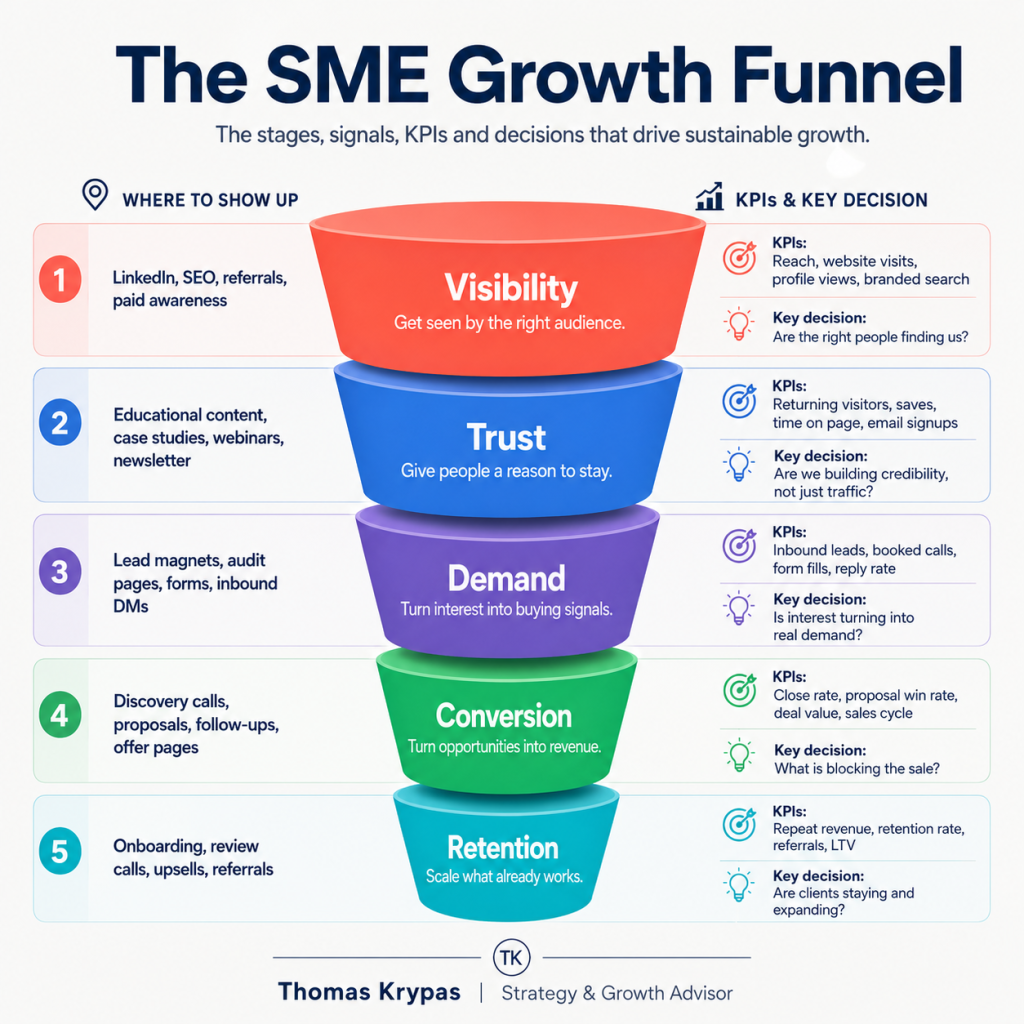
The SME Growth Funnel splits growth into five stages, each with its own channels, its own metrics, and its own decisions:
Visibility, Trust, Demand, Conversion, Retention.
Let’s walk through each one.
Stage 1. Visibility: Are the Right People Finding You?
Visibility is the top of the funnel. It’s the moment people first learn your business exists. For an SME, it comes from LinkedIn, SEO, referrals, paid awareness, partnerships, events, media mentions, and word of mouth.
But visibility isn’t about being seen. It’s about being seen by the right people, for the right reason.
This is where the first mistake usually happens: chasing impressions, followers, and traffic without asking whether that audience matches the clients you actually want. A business can have enormous reach and zero growth.
Metrics to watch: reach, website visits, profile views, branded search, direct traffic, referral traffic.
The decision to make: not “how do we get more views?” but “are the right people finding us, and do they understand what we want to be known for?”
Stage 2. Trust: Are You Building Credibility or Just Traffic?
Once people find you, they don’t buy. They observe.
They check your website. They read a post or two. They look for proof. They compare you to alternatives. And they quietly ask themselves: do these people actually understand my problem?
Trust is built through educational content, case studies, testimonials, webinars, newsletters, clear positioning, and evidence of past work.
For many SMEs, this is the weakest link in the entire funnel. They have visibility, but their content doesn’t educate. They have a website, but it doesn’t explain value. They have years of experience, but it’s never been packaged into proof.
Metrics to watch: returning visitors, time on page, saves and comments, email signups, webinar attendance, case study views.
The decision to make: are we building credibility, or just generating traffic? Because traffic without trust rarely becomes revenue.
Stage 3. Demand: Is Interest Turning Into Buying Signals?
Demand is where passive attention becomes active interest. Someone downloads a guide, fills in a form, books a call, asks for pricing, or sends an inbound message.
Here’s the distinction that matters: demand is not lead volume. It’s buying signals.
A like is not demand. A view is not demand. A random comment is not demand. Demand appears when someone takes an action that moves them closer to a business conversation.
This is exactly what lead magnets, diagnostic calls, scorecards, audit pages, workshops, and email sequences are for: moving people from “this is interesting” to “I want to know more.”
Metrics to watch: inbound leads, booked calls, form fills, reply rates, qualified leads, visitor-to-lead conversion.
The decision to make: is interest turning into real demand? If not, the fix is usually a clearer offer, a stronger call-to-action, a better lead magnet, or sharper audience targeting. Not simply “more marketing.”
Stage 4. Conversion: What Is Blocking the Sale?
Conversion is where demand becomes revenue: discovery calls, proposals, pricing conversations, demos, follow-ups, negotiations.
Many SMEs assume that if leads are coming in, sales will naturally follow. Conversion, however, has its own failure points:
- The offer is unclear.
- The proposal is generic.
- The pricing isn’t connected to value.
- The follow-up process is weak.
- The sales conversation talks about features instead of business outcomes.
Metrics to watch: close rate, proposal win rate, average deal value, sales cycle length, follow-up response rate and, critically, the reasons behind lost deals.
The decision to make: what exactly is blocking the sale? Sometimes it’s price. Sometimes timing. Sometimes trust. Often, the offer simply isn’t packaged in a way that makes the decision easy.
That’s why conversion is never just a sales issue. It’s a positioning, messaging, trust, and offer-design issue.
Stage 5. Retention: Are Clients Staying and Expanding?
For most SMEs, the funnel stops at the sale. That’s a costly mistake.
Real growth happens when clients stay, buy again, expand the relationship, refer others, and become advocates. Retention covers onboarding, review calls, reporting, renewals, upsells, referrals, and ongoing communication.
This matters most for service businesses, B2B companies, agencies, consultants, SaaS products, and training providers. In short, any business that doesn’t want to survive on new acquisition alone.
Metrics to watch: repeat revenue, retention rate, customer lifetime value, renewal rate, upsell rate, referrals, churn.
The decision to make: are clients staying and expanding? If not, the problem may have nothing to do with acquisition. A company that constantly needs new clients because existing ones leave has a growth efficiency problem, and no ad budget can fix that.
Why This Framework Changes the Conversation
A clear growth funnel replaces guessing with diagnosis.
Instead of “we need more marketing”, the business can now say:
- “We need visibility with the right audience.”
- “We have traffic, but not enough trust.”
- “We have interest, but not enough qualified demand.”
- “We have leads, but conversion is weak.”
- “We close clients, but we don’t retain or expand them.”
Each of those sentences points to a specific fix. Marketing stops being random activity. Sales stops being reactive. Content stops being just posting. Ads stop being just spending.
Growth becomes a system.
The Problem Is Rarely the Channel
When growth stalls, most SMEs reach for a channel change. Facebook to LinkedIn. Organic to paid. Posts to newsletters. One agency to another. One tool to the next.
But the channel is rarely the problem. The problem is that the journey from visibility to trust, trust to demand, demand to conversion, and conversion to retention has never been mapped.
Some hard truths:
- A new channel cannot fix an unclear funnel.
- AI tools cannot fix unclear positioning.
- Ads cannot fix weak trust.
- Content cannot fix a poor offer.
- A new website cannot fix a broken sales process.
The channel matters. The system matters more.
A Practical Way to Start: Five Questions
You don’t need a consultant’s toolkit to begin. Start with five questions:
- Where are we currently visible?
- Do people understand why they should trust us?
- What actions show real buying interest?
- Where do we lose people before they become clients?
- What happens after the first sale?
Simple questions, but they reveal exactly which problem you have: visibility, credibility, demand, conversion, or retention.
And once the leak is clear, the next move becomes obvious.
Final Thought
Most SMEs don’t need to do more of everything. They need to understand what’s working, what’s leaking, and what decision each stage of the funnel requires.
Growth is not more campaigns, more content, more ads, or more tools.
Growth is a system where the right people find you, trust you, show interest, buy from you, and stay with you.
That’s the real role of the SME Growth Funnel. Not to make marketing more complicated, but to make growth easier to diagnose, manage, and improve.
Not sure which stage of the funnel is leaking in your business? Start with the five questions above, or get an outside pair of eyes on your funnel with a short diagnostic session.
